Sherborne
Summer School of Music
2026
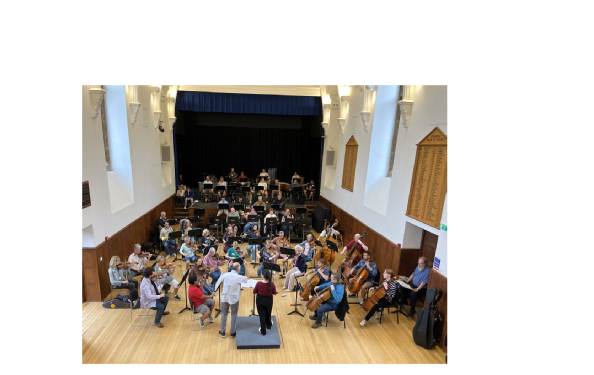
The George Hurst Conductors’ Course 9th to 16th August
Colin Metters Course Director
with Robert Houlihan and Natalia Luis-Bassa
assisted by David Smith
Key Features
Our purpose is to enable students to understand and conduct significant orchestral repertoire in a way that is clear, distinct and musically rewarding.
The course is designed for conducting students in full time study, professional performers, teachers and conductors in education and amateurs.
The ethos is inclusive, collaborative, friendly and supportive.
All participants receive podium time in individually tutored workshops with the class ensemble or piano. They will also have time (adapted to individual abilities) in ‘repertoire sessions’ working with a larger orchestra in the afternoons Monday to Thursday and on Thursday evening. A camcorder will be available in orchestral sessions: students are asked to bring their own labelled SD card if they wish to create a record of their work.
The course is structured to provide all students with daily technique sessions, musicianship classes, score preparation and rehearsal techniques.
Observers are welcome from all musical backgrounds and at any level and can participate in the technique sessions and the class orchestra.
George Hurst made an immense impression on orchestral conducting in the last half of the 20th century. He was enormously admired for his musical integrity and for his outstanding ability to foster the talents of emerging conductors.
As a teacher at the Sherborne Summer School of Music (formerly Canford) and the Royal Academy of Music he taught many now famous names including Sir Simon Rattle, Sir Andrew Davies, Sir John Eliot Gardiner, Edward Gardner and Mark Wigglesworth and his name is associated with remarkable regularity as the teacher who set many aspiring young conductors on careers of note.
The George Hurst Conductors’ Course is internationally recognised as one of the foremost summer programmes for training conductors. Students from intermediate to advanced levels are invited to hone their craft through practical experience and tuition that is focused on their individual needs.
Brahms
Liadov
Mozart
Ginastera
Mendelssohn
Symphony No.4 in E minor, Op.98
Eight Russian Folk Songs, Op.58
Symphony No.36 in C, K.425 (Linz)
Estania
Incidental Music to “A Midsummer Night’s Dream”, Op.61
Overture, Scherzo, Intermezzo, Notturno
Eulenburg
IMSLP#767212 (free download)
Barenreiter
Boosey & Hawkes
Eulenburg
Repertoire:
(Any reputable edition is acceptable but in case of doubt the following
editions are recommended)
All students are expected to prepare the course repertoire as thoroughly as possible before commencement of the course to gain full benefit from the tuition offered.
Participants who play orchestral instruments are asked to bring them to play in the class ensemble. Students who are competent pianists will be asked to assist with playing piano reductions and may wish to acquire knowledge of them before the course begins.
The course will start at 14.30 on Sunday afternoon. In this session all students will be invited to conduct a short section of a movement of their choice from the set repertoire so that the tutors can make a preliminary assessment of their requirements.
George Hurst Conductors’ Course Application Form
Please note. The summer school does not have a music shop on site. Students should acquire their course materials before they arrive at the school either from their local music shop or from our nominated internet supplier, Forsyth Music where you will find the music for your course ready to purchase
https://www.forsyths.co.uk/189389-sherborne-summer-school-2026